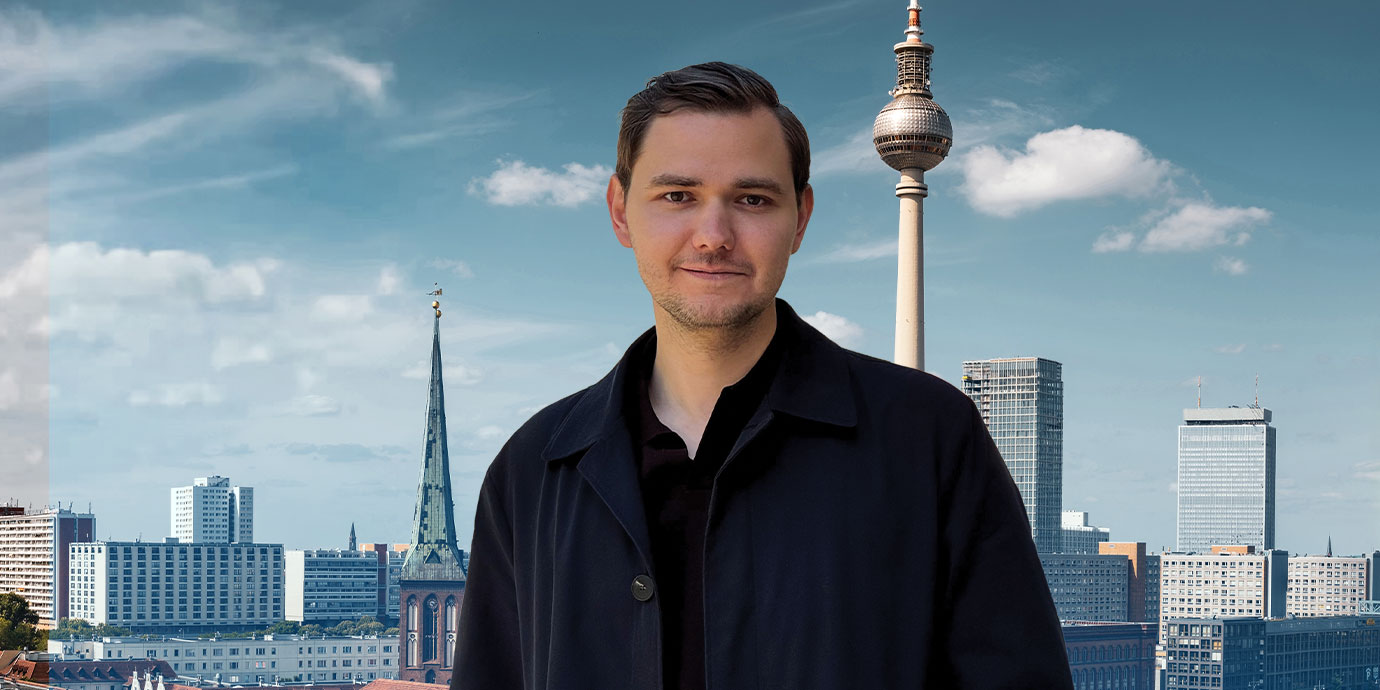
The prevention pioneer
AI-focused postdoctoral researcher Dr Marvin Kopka has already achieved more by the age of 29 than most will in a lifetime.
Marvin grew up in a small town named Bennekenstein, in Germany, and had to move away for both university and his career. While he has worked internationally, he currently lives in Berlin working at Technische Universtät Berlin.
He was always interested in technology, but when picking what to study, he felt torn between psychology, medicine, and computer science. After a brief period studying psychology, Marvin turned to human factors and public health, enabling him to focus on impacting the health of thousands or even millions of people, unlike physicians and psychologists who see far fewer patients and clients each day.
“I was very much into data science and statistics, so I started a doctorate in medical informatics [at Charité - Universitätsmedizin Berlin].
“At conferences, I noticed that the clinical people were speaking a different language. Nobody really had a background in humantechnology interaction, so that’s when I signed up for the Master’s in Public Health (MPH) at the University of Wolverhampton.”
Studying at Wolverhampton opened Marvin’s career like nothing before, giving him the technical terms and understanding he needed to speak to scientific peers.
“I gained the vocabulary and concepts I needed to know and a broad perspective on public health, which helped me see how the pieces fit together.
“I included my MPH in all my applications, because in Germany an MPH technically doesn’t exist, so having one can be a door-opener for conversations.”
Marvin’s PhD in Human Factors thesis saw him researching symptom checker apps, which are applications based on decision trees or other clinical algorithms to help work out what condition a set of symptoms may indicate. Before AI rose to greater significance, these apps were simpler and rule-based and always provided the same answers depending on what information was inputted.


Midway through his thesis, Marvin’s former supervisor advised him to incorporate AIdriven large language models (LLMs) into his research, suggesting that they may be the future of symptom checking.
“I ran symptom checkers and LLMs side by side. I would get participants to interact with the symptom checker and then get a second group to use the LLMs.
“Symptom checkers are rarely used now, but I think that 40-60% of people use LLMs to assess their symptoms. Looking back, it was a very good decision to switch my focus to AI and LLMs, as we still have a lot of work to do in that area because these tools are not regulated.”
Marvin’s career has taken him to some of the most esteemed institutions in the world. In 2023, he worked as a visiting scientist at Harvard University, Division of Digital Psychiatry, and focused on developing an algorithm and decision aid for mental health app rankings and recommendations. Then in 2025, he began contributing research at Imperial College London, in a collaboration that has already seen him registered as an honorary research associate.
He said: “I sent a message asking if Imperial would be open to hosting a visiting scientist to start – and now we have finished it – a real-world evidence study protocol on the impact of symptom trackers. I applied and I got the funding, so then I stayed for four weeks at the Imperial in London.


“We’ve already published two or three preprints and we have way more projects in the pipeline, so this is a long-term collaboration where we publish on self-care and AI.”
Looking back, it was a very good decision to switch my focus to AI and LLMs.
Marvin is motivated to contribute to a field of research that he hopes will solve a pressing health problem worldwide, but which he says is especially prevalent in Germany.
He said: “If we need a doctor’s appointment with a specialist, we often have to wait several weeks or months. I think we technically have the resources to reduce waiting times, but patient re-direction is currently so inefficient and doesn’t make sense.
“With my research, I try to get the patient perspective into policy by publishing papers about what patients actually need.”
Last year, Marvin was awarded the Young Alumni of the Year at the University of Wolverhampton Alumni Awards.
“It was amazing,” he said. “The biggest thing, but I was sick at the time so I couldn’t make it to the ceremony. I have the trophy sitting on my desk because I’ve never received anything like it before.”
Marvin says that he doesn’t have one ultimate career goal, but takes things step by step, knowing that plans may change along the way. What matters to him is that his research contributes something meaningful to society.
“In the long run, I’d love my work to improve or save lives, by developing technological interventions or maybe personalising large language models, helping us understand the health decisions people make on a deeper level.”


