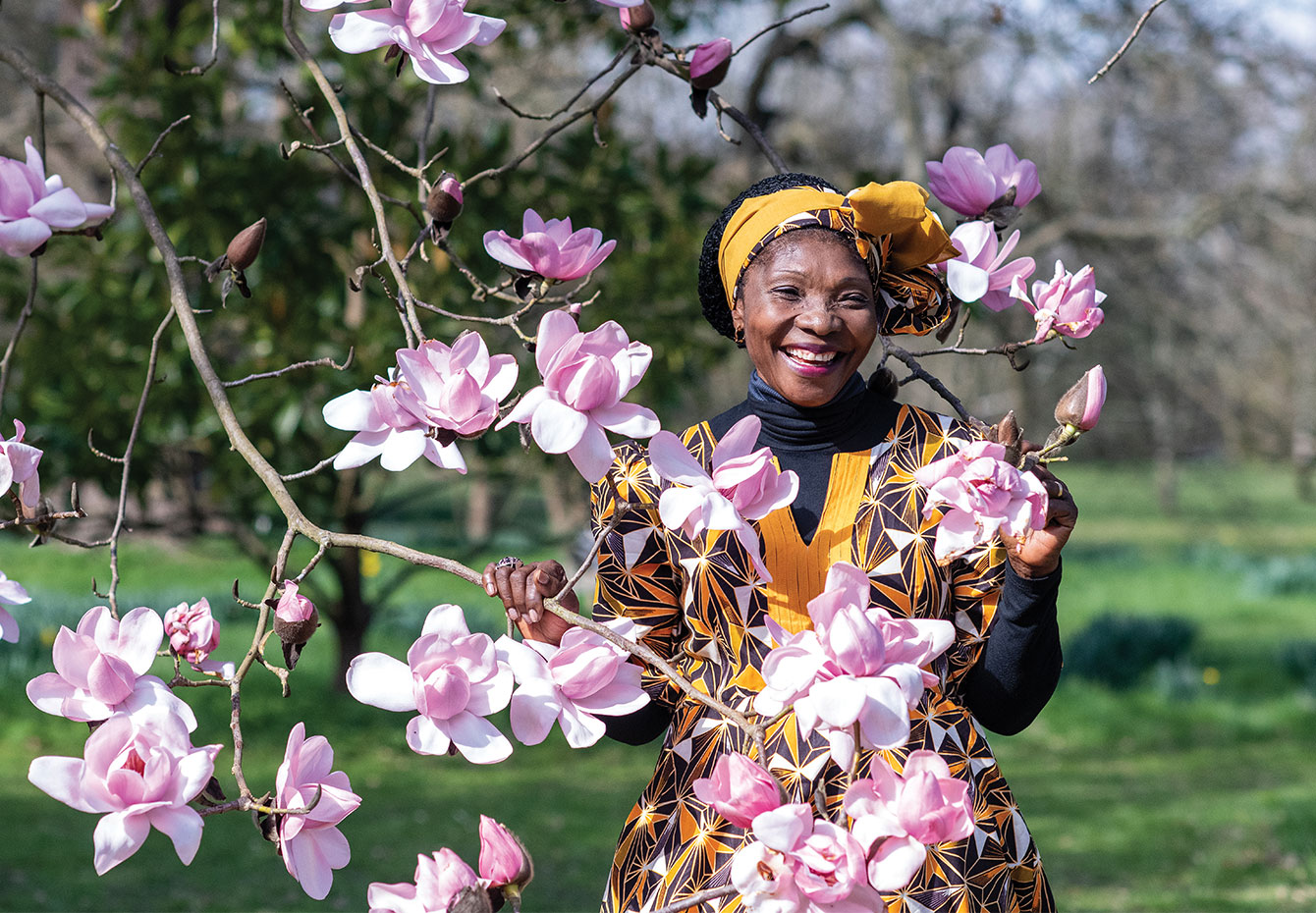
Mother Earth
Dr Cécile Ndjebet: a force for forests
Everything Dr Cécile Ndjebet has done can be traced back to a single phrase: “Hi sii hi tii nin” – Mother Earth. In her native language, the words carry meanings that stretch far beyond translation. They reflect belonging, responsibility, community and care. For Dr Ndjebet, Mother Earth is not a metaphor. She is a living presence, a provider, a teacher, and ultimately a cause worth spending a lifetime defending.
Today, Dr Cécile Ndjebet stands as one of Africa’s most respected environmental activists – a Cameroonian social forester, agronomist (a scientist working with soil management, crop production and sustainable farming), policy influencer, and internationally recognised champion of women’s rights, forest conservation, and sustainable land management. Her career has fused environmental stewardship with gender justice, transforming rural women from invisible users of land into recognised custodians and rights holders. And she traces the launch of that global journey back to a modest but decisive beginning: her time studying at the University of Wolverhampton, on a course that, she says, “became the foundation of my entire career.”
Forest and family
Dr Ndjebet was born into a large farming family near Edea in the Littoral region of rural Cameroon, the ninth of fourteen children, living in “a little house with a raffia roof.” At just three years old, she was taken by an older sister to live with her upon marriage, according to cultural custom. Her sister and her husband became her first parents, nurturing her until she returned to her biological family at the age of ten.
“I was one of the luckiest,” Dr Ndjebet recalls. Her brother-in-law was a Catholic primary school teacher who ensured she could attend school, cycling with her daily, talking, explaining, shaping curiosity. Education was not inevitable – her family worked hard for it, and it was precious. It was at this time that she discovered that her brother-in-law earned only $1.50 per month.
But her deepest education happened elsewhere: in the forest. “We were in a real tropical forest,” she explains – humid, hot, and rich with biodiversity. From the time she could walk, little Cécile accompanied her mother and sister into the surrounding woodland. The forest was central to daily survival. “We were collecting everything from the forest,” she explains. “Food, water, medicine… I think it was only dresses that we could not make from the forest!”
That intimate reliance, gathering fruit and fungi, firewood and medicinal plants, instilled not only respect but profound understanding. The forest was not an abstract ecosystem – it was shelter, sustenance, and safety. It was also the place where she first observed the quiet, exhausting labour of women.
“I remember my mother was the last to go to bed and the first to get up, at four o’clock in the morning,” Dr Ndjebet says. She watched her mother and sister farm, gather, cook, care, and lead households – while holding little formal power. Even as a child, the injustice was clear. “I felt, ‘When I grow up, I will defend your rights.’”
From civil servant to changemaker
Dr Ndjebet began her professional life as a civil servant, working first in Cameroon’s Ministry of Agriculture and later in the Ministry of Environment and Forestry. These roles brought her close to policy, but something was missing. Forests were being managed technically, she felt, without enough attention to the people – especially women – who depended on them most.
A pivotal shift came when she undertook a four-month professional training course on gender and community forestry at the University of Wolverhampton’s Centre for International Development and Training. That experience, she says, reshaped everything: “I wanted to learn about the interaction between forests and people,” she explains. “Not to be an engineer working with trees and wood, but to work with communities.”
The training equipped her with practical tools she still uses decades later: community entry techniques, participatory dialogue, understanding power dynamics at household level, and working with early adopters to build trust gradually. “That course was the foundation – like the foundations of a house,” she reflects. “I’m still using what I learned in Wolverhampton today.”
Its impact was concrete. Armed with new insights, Dr Ndjebet contributed to policy reform in Cameroon, helping shape the country’s 1994 community forestry policy, helping to legitimise community-managed forests – a major shift that continues to influence forest governance across the region.
“I learned that if you don’t work with husbands and fathers, you cannot change anything sustainably.”


Encountering a continental vision
Another defining moment arrived in 2009, when Dr Ndjebet met Professor Wangari Maathai – the late Kenyan activist and Nobel Peace Prize laureate. Standing in the forest, alongside Dr Ndjebet’s own mother, she says, “changed my life.” Maathai entrusted her with a mission: mobilise African women to plant trees – especially fruit trees. Trees that would nourish families, generate income, and restore degraded land. Trees that would mitigate climate change while strengthening food independence. “‘And the whole world will be grateful to them’, Wangari Maathai told me.”
Dr Ndjebet accepted the call without hesitation. From that moment, mobilisation became central to her work – not as a slogan, but through sustained work with communities, rooted in women’s knowledge and experience.
Founding REFACOF
Out of that vision, in the same year, Dr Ndjebet founded REFACOF – the African Women’s Network for Community Management of Forests (Réseau des Femmes Africaines pour la Gestion Communautaire des Forêts) which puts women at the centre of forest governance. Today, the network operates in 20 countries, advocating for women’s land rights, supporting restoration and linking biodiversity protection with poverty reduction.
At the heart of REFACOF’s work lies a stark paradox: women produce up to 80 per cent of the food consumed in their communities, restore degraded ecosystems, and manage forests daily – yet rarely own the land they depend on. Lacking formal tenancy or contracts, they are excluded from decision-making, financing, and long-term security.
REFACOF addresses that gap through policy advocacy, grassroots mobilisation, legal reform, and community dialogue. It brings women into spaces from which they have historically been excluded – from village councils to international climate forums – while grounding its work in the day-to-day reality of rural communities.
As one partner, Lorene Moran-Valenzuela, from the Rights and Resources Initiative (RRI) notes, REFACOF “represents so many women on the ground we really want to support, that we think deserve to have their voices elevated and represented in international space.”


London Climate Week.
Securing land through culture and consent
Over time, Dr Ndjebet realised that working only with women was not enough. Power, she observed, sat first within the household. “I learned that if you don’t work with husbands and fathers, you cannot change anything sustainably.”
This insight led to a family-centred approach: engaging men, women and youth together, while placing women and girls at the heart of change. It was a delicate balance. “When you talk about women’s rights, you can meet resistance immediately,” she explains. “But when you start from family security, food, income and the future of children – men begin to listen.”
One of her most impactful innovations emerged from this approach: customary land allocation certificates, known locally as Lilaglè – “my customary will”. In many rural communities, women could work land but never own it. Without security, they could not plant trees, restore degraded land or invest long-term.
Through Lilaglè, husbands formally allocate land to wives via written certificates, witnessed by community leaders. The land cannot be sold outside the family and passes to the children, easing men’s fears while securing women’s rights.
The impact has been striking. In one pilot alone, 35 women gained ownership of 100 hectares of land – many having never owned even a single plot before. With land security, women began planting fruit trees, restoring ecosystems and generating income.
“If a woman has security,” Dr Ndjebet says, “you will be impressed by what she can do.”
The model is now being scaled across REFACOF’s 20-country network.
“Women are the solution,” she says. “We know what needs to be done.”
Recognition and responsibility
Dr Ndjebet’s work has earned significant international recognition, including the 2022 Wangari Maathai Forest Champions Award, and United Nations’ Champions of the Earth Award for Inspiration and Action, 2022. Selected by a global jury, this prestigious award recognises those who “have taken bold environmental action in urging and creating decisive positive change on behalf of the planet and its inhabitants.”
In 2025 she received the Kew International Medal, awarded by the Royal Botanic Gardens, Kew, to individuals whose work has significantly advanced global understanding of plants and ecosystems. Past recipients include luminaries such as Sir David Attenborough and Juan Manuel Santos, former President of Colombia.
For Dr Ndjebet, the medal changed everything. “It opened doors,” she says simply.


at Buckingham Palace.
A renowned and sought-after speaker, just days after the ceremony to receive the Kew Medal at The British High Commission in Yaoundé, Cameroon, Dr Ndjebet was received by His Majesty King Charles III in the UK during London Climate Week.
She spoke frankly about the lack of funding for women-led environmental action. The King was visibly moved and instructed his team to support her work.
That moment translated into concrete outcomes. Connections with ambassadors, donors and private-sector partners have led to new collaborations already underway across Africa and internationally. REFACOF has since secured a five‑year partnership with The Nature Conservancy, including immediate funding to expand women-led restoration programmes. Cameroonian authorities have pledged national support for women-led tree planting initiatives.
Visibility, she notes, matters – not for prestige, but for possibility. “The more people see the work, the more support we can bring to rural women.”
A call rooted in experience
Despite global impact, Dr Ndjebet remains deeply grounded in humility and urgency. The challenges are immense: climate change, biodiversity loss, land inequality, and rural poverty intersect daily in the lives of women she works with. Yet her message is unwavering.
“Women are the solution,” she says. “We know what needs to be done. Please give us the tools – and you will be impressed by the impact we can produce.”
From a childhood in Cameroon’s forests to meetings with kings, Dr Cécile Ndjebet’s journey proves what can grow when knowledge, justice and Mother Earth are nurtured together.
Through her life and work, Mother Earth speaks – and is defended – by the women who know her best. And it always circles back to her mother’s words, carried across languages and landscapes:
“Love forests.
Care for forests.
Respect forests.”


