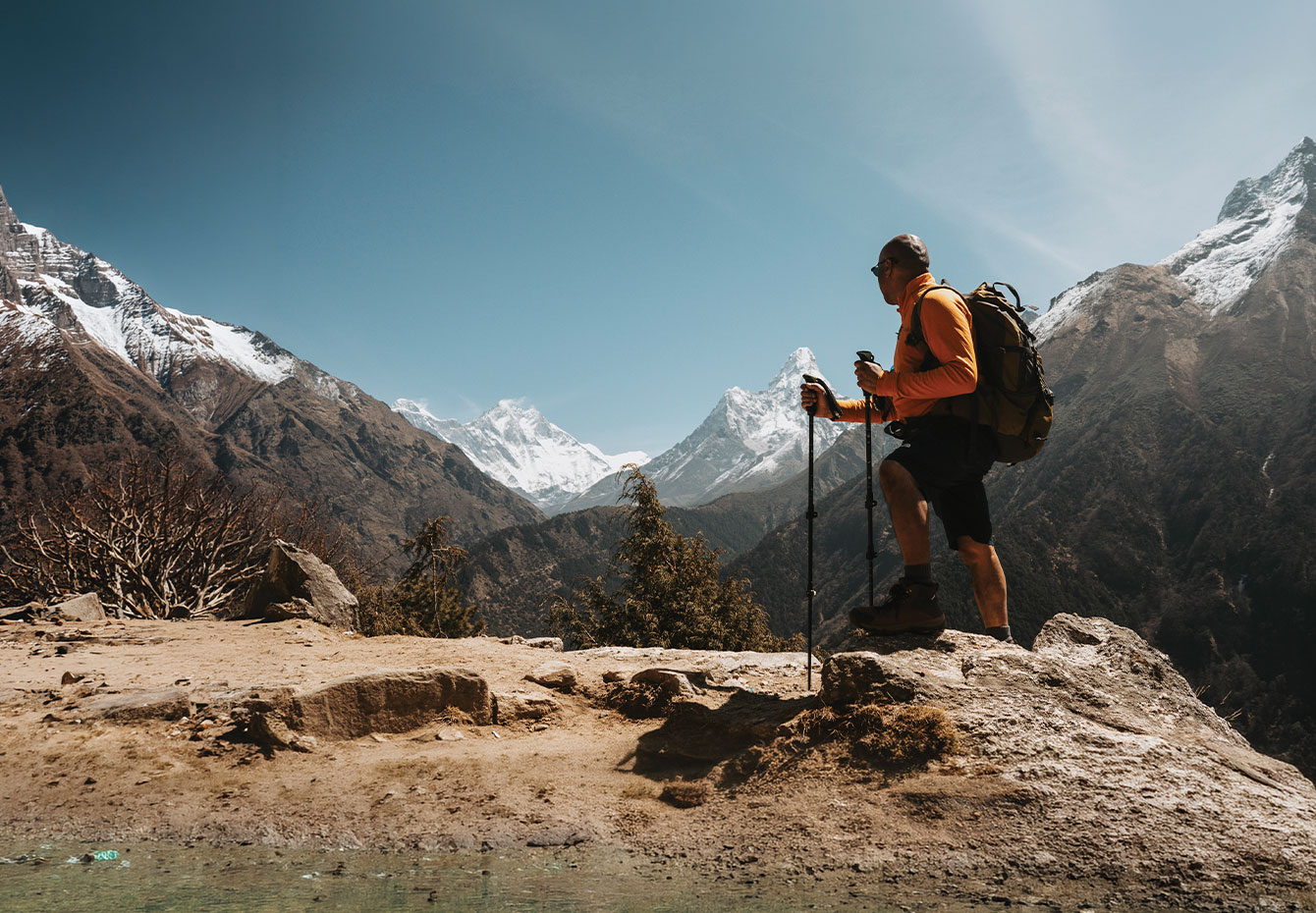
Where dreams meet altitude
For more than 20 years, Pritesh Patel has been a familiar face at the university, quietly contributing his skills as a graphic designer within the print services team. He also studied at the university, graduating in 2004 in graphic communication.
Known by colleagues as approachable and unassuming, he’s not necessarily the person you’d expect to have recently stood at 5,360 metres, gazing up at the world’s highest peak.
Yet this spring, Pritesh did exactly that – completing the demanding trek to Everest Base Camp in Nepal, a feat that blends endurance, resilience and a deep love of the outdoors.
“I’ve always been into hiking and walking,” he says. “It’s something I’ve just always enjoyed.” Like many, the idea of Nepal first surfaced as a travel aspiration years ago, only to be shelved after a severe earthquake in Nepal in 2015 disrupted his plans. The dream quietly faded – until lockdown rekindled his passion for hiking.


Then came a turning point. Approaching his 40th birthday, Pritesh set his sights on Everest Base Camp. The trip was postponed after he experienced a serious period of ill health, but the goal remained. “I’d always wanted to do it,” he explains simply. “So I booked it again and made sure this time I was going.”
By late March this year, that long-held ambition was finally within reach.
Preparation, he admits, was less about technical climbing and more about endurance. Having already conquered the UK’s three highest peaks: Ben Nevis, Scafell Pike and Snowdon, he focused on longdistance hikes and building stamina. “It’s about being out for hours and hours,” he says. “But also slowing down. On Everest, you have to go at a completely different pace.”
That slower pace is dictated by altitude. As oxygen levels drop, even the act of walking becomes a challenge. Guides encouraged a rhythm: one step, one deep breath. “You’re constantly thinking about your breathing,” Pritesh recalls. “At times, it’s literally just putting one foot in front of the other.”
The 14-day trek began with a flight into Lukla – one of the world’s most precarious airstrips – before winding through villages, forests and eventually stark, frozen terrain. Early days were deceptively comfortable, with clear skies and T-shirts sufficient at 3,000 metres. But beyond 4,000 metres, the landscape transformed.
“The trees disappear, the temperature drops, and it gets serious,” he says. Night-time temperatures fell as low as minus 20 degrees, with basic accommodation offering little more than a bed and shared facilities. Showers became a luxury replaced by wet wipes and ingenuity – such as using a hot water bottle to wash in the morning.
Despite the physical challenge, camaraderie defined the experience. Travelling with a group of strangers – seven trekkers and three Sherpas – Pritesh describes how bonds formed quickly. “By the end, we were like family. Everyone supported each other through the tough moments.”
And there were tough moments. Long days, thinning air and mental fatigue pushed everyone to their limits. One fellow trekker suddenly and briefly lost consciousness, a stark reminder of the environment’s unpredictability. Thankfully, Pritesh and his trekmates were with him to prevent him falling. “It can be scary,” Pritesh admits. “The mountains don’t discriminate.”
Yet the rewards were equally profound. The final approach to base camp – set on a glacier surrounded by towering peaks – was as surreal as it was exhilarating. “There’s a rock that marks the spot, and everyone queues for a photo,” he says. “But it’s more than that. It’s the feeling – you’ve made it.”


Standing there, looking towards Everest itself, brought a powerful sense of achievement. “We all realised how hard it had been,” he says. “There was just this collective feeling of ‘we’ve done it’.”
The journey left a lasting impression. Returning to the UK after three weeks, Pritesh found himself changed – physically tired, certainly, but also reflective. “It makes you appreciate things,” he says. “Even something as simple as hot water – you realise how easy life is here.”
He also describes the experience as unexpectedly spiritual, shaped by encounters with temples, prayer rituals and the rhythms of life in Nepal. “It wasn’t just the mountains,” he adds. “It was everything about the country.”


As for what’s next, conquering Everest itself isn’t on the agenda – but not for lack of ambition. “It was hard enough as it is,” he laughs. Instead, he’s already thinking about returning to the Himalayas to explore new regions, as well as tackling other iconic landscapes such as Kilimanjaro or the Alps.
For colleagues who may be surprised by his achievement, Pritesh remains characteristically modest. But his journey is a reminder that extraordinary experiences often belong to ordinary people – with enough determination, curiosity and courage to take that first step.
Or, in his case, many thousands of them.
From student to staff. If you’re a University of Wolverhampton alum working here today, share your achievements and inspire fellow graduates.
Contact us at alumni@wlv.ac.uk.


