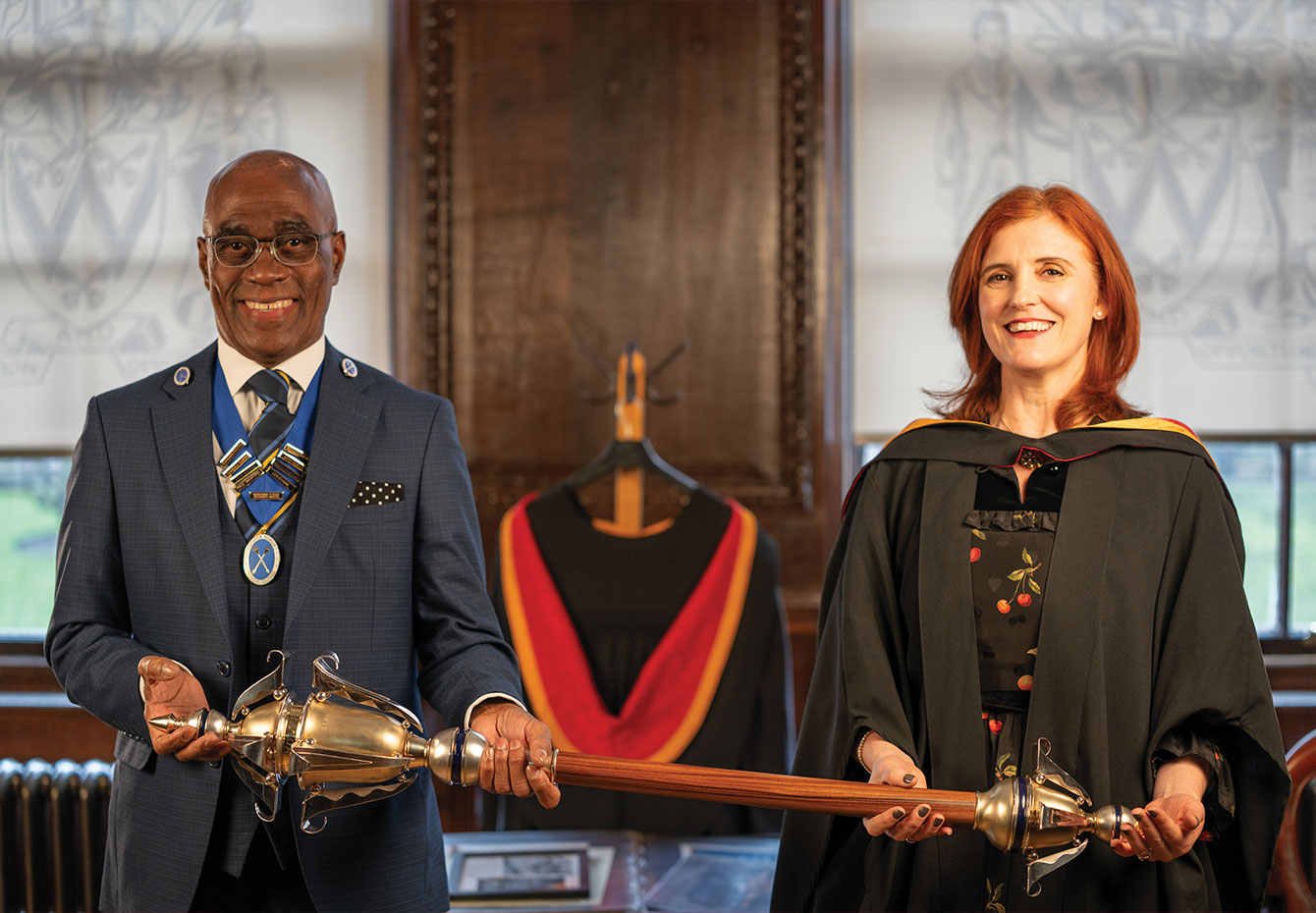
Shaping a graduation tradition
Every graduation ceremony at the University of Wolverhampton begins the same way: the formal procession, the rustle of academic gowns, the anticipation in the hall. At its centre is a gleaming ceremonial mace, carried with pride and reverence. For years, it has symbolised academic authority and shared achievement. What many graduates don’t know, at least not until recently, is that this iconic object was designed and made not by an external craftsman, but by a fellow student.
More than 30 years ago, Marianne Pughe (née Saunders) was studying on the university’s 3D Design: Wood, Metals and Plastics course when she was given an extraordinary opportunity: to design and make the university’s ceremonial mace. Now, more than three decades on, Marianne returned to campus to see her work still in use and to revisit the place where her creative journey truly began.
“It was an amazing piece to make,” she recalls. “At the time, you don’t necessarily realise the weight of what you’re creating. Seeing it still being used, and carried so proudly at graduations, is incredibly special. It brings back so many memories of my time at Wolverhampton.”
The mace itself is unapologetically bold – substantial in form, rich in material and presence. Its scale and solidity reflect its role in ceremony: something designed to be seen from afar, to command attention and mark the significance of the occasion. For Marianne, still a student honing her technical and conceptual skills, it was a challenge that drew on everything she had learned.
Studying applied design across materials gave her a deep respect for process and craftsmanship, as well as the confidence to tackle ambitious projects. During her studies, she had already made the Student Union medal (still used at ceremonies today), as well as an award for Central Television, so her talent was already clear.
The mace was made in part to mark the university’s change in status from polytechnic to university in 1992. Being trusted with such an important commission was both daunting and exhilarating, and it left a lasting impression. “The course gave me freedom to explore, but also the discipline to make things properly,” she says. “That combination has stayed with me throughout my career.”
Particularly interested in silversmithing, Marianne was fortunate to get onto a fellowship design course in the Jewellery Quarter in Birmingham just after graduation. There she met her partner, Robert Pughe, establishing their company Saunders & Pughe.
Marianne went on to build an acclaimed career in jewellery design. Today, with FGA and DGA fellowship of The Gemmological Association of Great Britain, she runs Saunders & Pughe Goldsmiths, in Corbridge Northumberland with Rob, creating fine jewellery that could hardly appear more different from the mace that still defines Wolverhampton’s pageantry. Where the mace is large, weighty and ceremonial, her contemporary jewellery is intricate, delicate and intensely personal.


Credit: The Royal Countryside Fund:
www.royalcountrysidefund.org.uk
Her studio’s work is characterised by close attention to detail and a sensitivity to materials – precious metals and gemstones shaped into elegant, wearable forms. Much of what Saunders & Pughe creates is designed to mark life’s most meaningful moments: engagements, anniversaries, commitments and celebrations. In that sense, the connection to the mace remains. Both are objects present at moments people remember forever.
Marianne’s success has been widely recognised. She travelled to London’s prestigious Westminster Hall to collect the Gemmological Association of Great Britain’s 2017 Bruton Medal: a prize awarded to exceptional students with the best results in the Diamond Diploma examination.
Saunders & Pughe Goldsmiths won Designer Retailer of the Year from the National Association of Jewellers in 2022, and were commissioned to create a special gold lapel badge for the Royal Countryside Fund, which was presented to His Majesty King Charles III, they have recently been shortlisted for the Heritage and Creativity Award from The Company of Master Jewellers. Yet, despite such national recognition and royal connections, her return to Wolverhampton in January 2026 was deeply personal.
Invited back to see the mace carried during graduation once again, Marianne described taking a “trip down memory lane”.


Watching graduates queue to have their photographs taken with the mace – an informal tradition that has grown over the years – was particularly moving. “Graduation is such an important day for people,” she reflects. “To know that something I made as a student is part of that experience for so many is an honour.”
University colleagues see the rediscovery of the mace’s origins as a powerful reminder of the lasting impact of a Wolverhampton education. For students past and present, Marianne’s story is proof that the work created in workshops and studios can resonate far beyond the university years.
As the mace continues to lead each graduation procession, it carries not just institutional authority, but the legacy of an alumna whose creativity began in Wolverhampton, and whose work, in many forms, continues to mark life’s most important moments.


